Reiner Niehoff
Ladies and Gentlemen,
The paintings by Ute Pleuger that you see in this exhibition span a ten-year period of creation; the early gouaches date from her two-year study sojourn in Paris between 1983 and 1985, while the most recent works—the “Corner Houses” (*Eckhäuser*) series—were produced this year. Yet, it is evident that they share a common theme: the city—facades of front and rear buildings, rows of houses, high-rises, single-family homes, and plain, unadorned walls. It is a theme that has been sustained, developed, and varied over the course of a decade. Through the use of diverse techniques—gouache, oil painting, and linocut—the subject matter is progressively pared down and rendered into a stencil-like form.
The early Parisian gouaches mark the beginning, both chronologically and thematically. Their structure is clear: from an “interior” space—delineated and framed by the crossbars of a window, in keeping with a Romantic tradition—the gaze falls upon a facade, which shifts and shimmers in the light of late afternoon or, at times, the near-darkness of night. The subject here is not so much the facade itself, but rather the act of looking at it. It is this gaze that imposes an order upon the light—a strictly composed arrangement, anchored by the window frame and given a rhythmic quality through the sequence of multiple images. It is an ambivalent gaze: simultaneously constructive and contemplative, it casts a veil of darkness over the external world. To my mind, this complicity with the night suggests a mystical perspective—one in which the inner and outer realms, teetering on the verge of dissolution, interpenetrate within the dark order of the painting.
In contrast to the gouaches, the large oil paintings initially appear far more realistic. Balconies, windows, and building facades emerge with a tangible, three-dimensional quality—stripped of all ornamentation, as if such decoration were a crime. The sun is clearly the source of light. The “inner space” of the viewer has vanished. Yet, this realism is unsettling. For one thing, the “light” here is nothing more than bare, exposed canvas—which, through this curious painterly inversion, seems to radiate light itself. Furthermore, the oil paint is not so much applied to the surface as it is rubbed into the canvas. This technique creates a distinctly surreal effect: the solid facades appear transparent—not like a painting, but like the projection of one. Viewed against the backdrop of the gouaches, the significance becomes clear: these works represent the imagination of that very same gaze which defines the Paris-themed paintings. Despite their realism, Ute Pleuger’s images are depictions of an “inner experience.”
As such, they are as fascinating as they are uncanny. The endless repetition of a few basic elements—windows, balconies, and cornices—coalesces into sequences that seem to have always been underway; after gliding briefly across the canvas, they continue on, unchanging and indifferent. This is mirrored by a compositional approach in which the windows and balconies are not aligned with the frame, but are instead “cropped” at the edges, suggesting that they continue beyond the boundaries of the picture.
This interplay between the monumental stillness of the facade and the dynamism of the recurring basic elements is further underscored by the fact that the paintings are segmented into multiple parts, with sequences extended or repeated through a series of arrangements. While the overall constructive plan of the paintings is clear-cut, the asymmetrical subdivisions—along with the principle of highly varied cropping applied within them—create a kind of fluid repetition.
Furthermore, the image formats reach dimensions that prevent the viewer from grasping the picture as an optical totality—that is, “at a single glance.” The result is an unfixed gaze, drawn into the movement of the image, into its undertow. Yet, where an instantaneous, total view of the image becomes impossible—giving way instead to the tracing of a fluid movement of elements—the image generates time. And time is precisely what these images are about: time as an eternal recurrence, as an overwhelming fatality. In a sense, Ute Pleuger’s images attempt a “re-fatalization” of our disenchanted world.
They appear “overwhelming” due to their extreme, fragmentary magnification, often combined with a pronounced low-angle perspective. Moreover, the images are stripped of any ground or stability, leaving the viewer’s own vantage point in a state of suspension. Perspective-based vision is further unsettled; for instance, in the 1993 series *Eckhäuser* (“Corner Houses”), the overhanging, ascending balconies widen toward the top, rather than narrowing as one might expect. These balconies aggressively occupy the space, looming with their lightless windows into a sky that seems increasingly pushed to the margins. The facades expand monumentally, yet without ever revealing—or even hinting at—what lies within, or the secrets they might hold. This, too, may point toward fatality. In any case, it makes it clear why Ute Pleuger developed a series of images based on a narrative by Franz Kafka.
The linocuts from 1992 go a step further than the oil paintings; they elevate the concept of the series to a central position. A printing template—which Ute Pleuger aptly terms a “stamp”—now establishes the identity of these representational, “stamped” elements. The motifs differ only by chance—arising from the spontaneous pressure applied to the stamp by hand, or the way black paint is brushed onto the linoleum block. Color has been eliminated from these prints, as has the warm light found in her gouaches and oil paintings. The grand facades have shrunk into houses, which now fill the pictorial space like an intricate mesh; they have been reduced to the status of a stencil. Gray packing paper serves as the substrate. Any lingering concession to the sensuality of her earlier work has been avoided with almost puritanical rigor. Yet, this very sense of inevitability has been transformed into an aesthetic method—for what could better express infinity—that “bad” kind of infinity—than a stamp?
And it is only the perspective introduced as a new vantage point—the view from above, followed, as it were, by Olympian laughter—that might hint at the direction in which Ute Pleuger’s exploration of the house and the façade will head: toward an ironic subversion of even her own intentions. For the terraced house, ladies and gentlemen—the terraced house is truly fatal. Thank you.
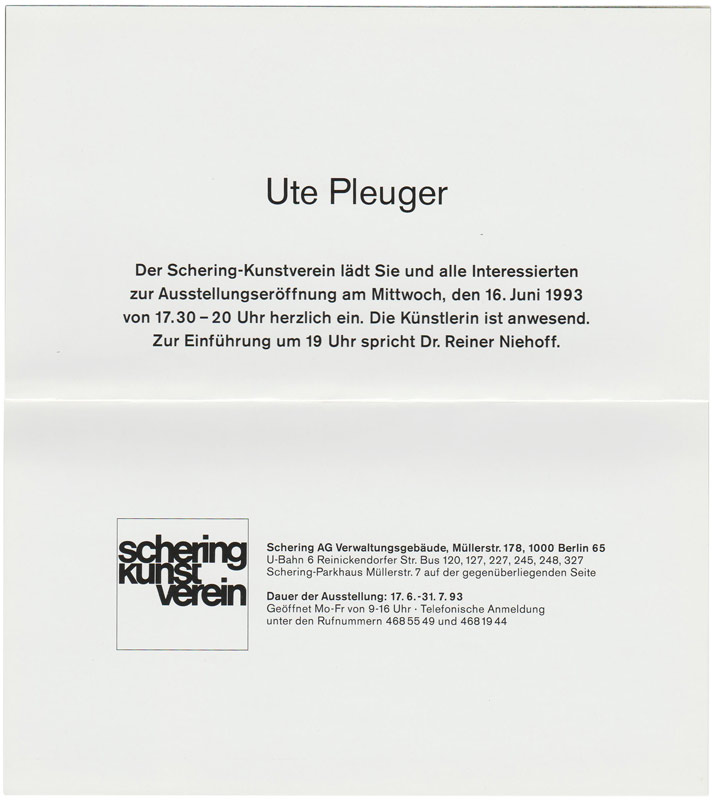
Opening speech for the exhibition at the Schering-Kunstverein Berlin on June 16, 1993