Matthias Schirren
Ladies and gentlemen, dear friends of the Werkbund-Archiv, dear Ute Pleuger,
You have titled this exhibition—which opens today and features your paintings from the past twelve years—“Serial Spaces.” The principle of seriality already underpinned the facades you painted in Paris in the mid-eighties. In contrast to their representational—and, by comparison, still somewhat figurative—approach, you gave them titles such as “Passacaglia” and “Fugue.”
Today, with the naturalistic and representational elements in your paintings reduced even further, the titles have become more subject-oriented, yet also more ironic: for instance, the works on paper here to my left are titled “Flood,” while the brick-like forms here to my right are called “Housing Blocks.” These titles should not be taken entirely seriously or, in a sense, literally—even though you have credibly assured me that the “Flood” paintings were prompted by television broadcasts of the Rhine floodplains in recent years—which reminded you of similar scenes from your youth in the Lower Rhine region—or that a stay in New York in 1993 inspired the “Parking Garage” piece here to my right.
The sense of bewilderment evoked by the titles of your images mirrors the quality inherent in the images themselves. For what one might call their subject matter—in the broadest sense: architecture, buildings, facades—recedes behind what is, in fact, their true theme: seriality.
Your images are serial in two respects: first, they are generally constructed from recurring elements that are either identical or nearly identical. Second, they lack a single, unifying vanishing point toward which all the objects depicted would be oriented and thus fixed. Instead of one vanishing point, your images possess several. Consequently, the objects depicted—or, more accurately, suggested—within the frame appear to be in motion. They move in a steady, uniform flow; you underscore this quiet, seemingly infinite movement by allowing the structures and window openings—arranged in rows and patterns—to extend beyond the edges of the image.
In your “flood” images, you have found a corresponding motif within the subject matter itself—though, characteristically, this is not a straightforward, naturalistic representation, but rather one with a double meaning. Upon closer inspection, one discovers that the small houses, which ostensibly protrude from the water, are rendered as if they were actually floating upon it. This buoyancy of the houses mirrors the sense of instability in one’s own perception—a state one inevitably encounters when examining your work more closely.
You derived the concept of the “serial” from your engagement with the music of Olivier Messiaen. In Messiaen’s work—particularly his organ compositions—there is no longer a single, unifying fundamental tone upon which a composition might be firmly anchored. Instead, his themes—constructed with meticulous precision in every element—remain in a state of suspension; they seem to drift like rotating celestial bodies in the vastness of space, orbiting only themselves, floating entirely free.
Seriality—as we might now better understand—does not imply the monotony of the eternally identical; rather, it suggests a quiet, drifting movement of objects that exist side by side, indifferent to one another, devoid of any hierarchical distinction.
For just as a single vanishing point functions in painting, so too does a fundamental tone function in music. It is no coincidence that, at the beginning of the last century, the breakthrough toward the abstract pictorial space of a Kandinsky occurred in close proximity to the experiments with atonal music—music liberated from a fundamental tone—by a composer like Schoenberg. Yet, unlike Kandinsky and those who followed him, you do not renounce the representational nature of your paintings. Whatever abstract or abyssal qualities emerge within them, they unfold, as it were, only behind or beyond the representational subject matter itself.
This also applies to the painting titled “Rotunda”—a work you created specifically for this exhibition, intended for the rotunda at the end of our sequence of rooms. Like the painting of the parking garage displayed here in this space, it leaves the viewer uncertain as to whether they are looking into a concave curve or at a convex one. Furthermore, much like the painting “Hospital,” which hangs opposite it in the rotunda, this work is constructed using multiple vanishing points rather than a single, unified one.
A word should also be said about the materiality of your paintings: the surfaces upon which you paint—kraft paper and canvas—are subsumed within the distinctive shimmer of your color palette. The extremely thin application of paint—a technique you adopted and further developed from your teacher at the University of the Arts, Bernhard Boes—imparts a luminosity to your works that seems to emanate from within, derived from the very materiality itself. To put it perhaps a bit provocatively: the function of the paint in your work is not to cover the substrate—the canvas or paper—but rather to make it glow. Consequently, the paintings cease to be mere media for conveying a representation; instead, they become things—objects with an existence of their own, transcending any purely depictive function. They are, in effect, objects capable of constituting a serial space of their own.
It is precisely this “thing-like” quality of your paintings that establishes a direct connection to the Werkbund Archive’s exhibition of its own holdings—the very context in which your work is being presented here. Angelika Thiekötter, our scientific director, and Renate Flagmeier have—within an installation of photo albums in glass cubes, created specifically for today’s opening—captured and brilliantly translated the interplay between enclosure and openness, between hermeticism and subjectivity, that characterizes your images.
Ladies and gentlemen, I would like to conclude this brief introduction by quoting a friend who was, at least indirectly, involved in the realization of this exhibition. You know who I mean, dear Ute—Reiner Niehoff—who, for reasons we both recall with sadness, is not with us today. I can, however, let him speak through a passage from a text he wrote some years ago about your paintings, titled “Facades.” This passage describes—better than I ever could—what prompted us at the Werkbund-Archiv to present your work in close spatial proximity to our own permanent collection exhibition. It reads:
“The extraordinary intensity that characterizes Ute Pleuger’s paintings stems from a sense of bewilderment and paradox. Her depictions of facades appear both solid and transparent; they seem deserted, yet they do not evoke loneliness. They confront the viewer as static objects—as things—while simultaneously manifesting as processes, as the movement of a grand, recurring cycle. Without a fixed vantage point, one finds oneself enveloped by a world that fascinates precisely because everything human has been omitted from it. Ute Pleuger’s paintings forgo any anthropomorphic scale, attaining instead the luster of a world that no longer bears the imprint of the human subject. These works open up an experience devoid of distance—an intimate encounter, an *expérience intérieure*.”
And with those words, ladies and gentlemen, I declare this exhibition open. Before I finish, I would like to draw your attention to the beautiful catalog—compiled specifically for this exhibition—which I highly recommend you purchase. I also invite you to take a look at the small brochure containing the text by Reiner Niehoff from which I just quoted. Thank you for your attention.
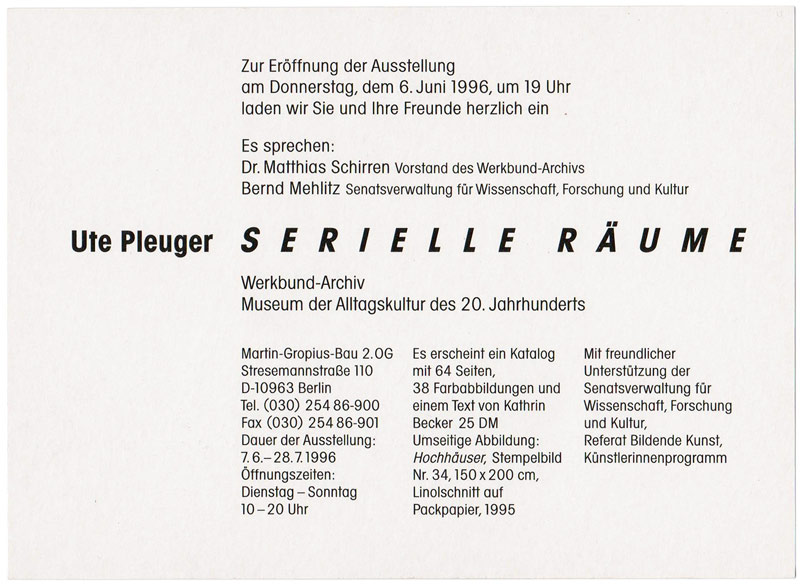
Opening speech for the exhibition “Ute Pleuger: Serial Spaces” at the Werkbund-Archiv in the Martin-Gropius-Bau, Berlin, June 6, 1996