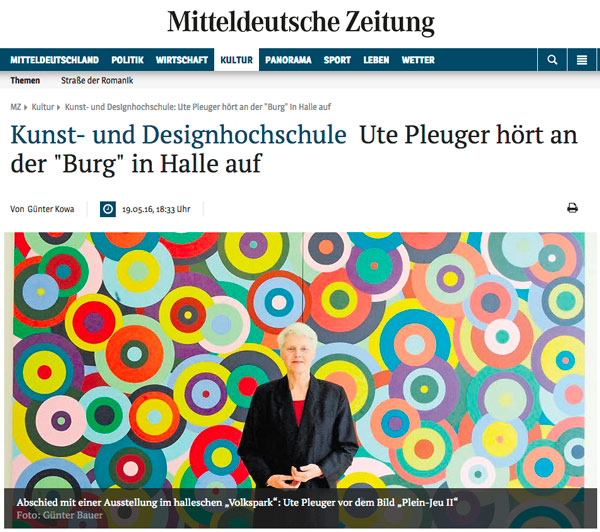
Günter Kowa: Ute Pleuger to leave the “Burg” in Halle
A period of transition lies ahead for the “Burg” (Burg Giebichenstein University of Art and Design). Over the next five years, 20 professors will be departing the Halle-based institution. The upcoming change in the painting department is set to attract attention well beyond the confines of the discipline itself. After 18 years of teaching, Ute Pleuger is handing over her brush and palette to a successor yet to be named. At the “Volkspark” venue and the gallery of the State Cultural Foundation, works by some of her nearly 90 graduates—alongside samples from her current students—are currently on display. Eighteen years: an era?
Her appointment certainly seemed to signal a break with the past. The painting program at the university had been reduced from four permanent faculty positions to just one—supplemented only by temporary visiting professorships and assistant roles (two of the latter are featured alongside Ute Pleuger in the entrance hall of the “Volkspark,” providing an overview of the department). With her slender frame, short silver hair, and gentle voice, the professor also appeared to be moving away from a certain tradition of classical painting. Her own work is defined by the concept of the series; painting is treated as an intellectual endeavor, where individual brushwork is reined in by structure, and any disruptions to the endless, repeating patterns that characterize her canvases are, at most, barely perceptible—though occasionally, as seen in the exhibited painting titled “Plein-Jeu II,” the colors become remarkably vivid.
Ute Pleuger does not typically appeal to emotions. Moods, premonitions, and dreams are not really her focus—yet these aspects of art were still given their due in her class. The fact that her teaching was highly valued is evidenced by the steady stream of students from near and far—including from the Far East—as well as by the success achieved by a significant number of her former pupils.
One senses the seriousness she brings to her work when hearing her speak about her approach. She might say, for instance, that it was both a duty and a joy for her to cultivate talent; she also notes that she would “confront” her students with specific criteria—urging them to derive the positions essential to their own artistic practice from the history of art. This process required great perseverance and, at times, struggle: “It is a process that takes years; we wrestled with it.” She would frequently remind her students that the art academy is funded by taxpayers and that, in return, it expects achievement—though in the realm of art, this occurs within a field that is, by definition, “unregulated.”
Learning and teaching in art has always been—and remains—a dynamic relationship defined by both attraction and repulsion. Does the student follow the master, or do they strike out on a different path? Those who explore the two exhibition venues will repeatedly encounter both proximity and distance. Despite an explicitly stated openness to a wide “breadth and diversity,” there are enough kindred spirits to suggest that Ute Pleuger has, in effect, established a school. The concept of the serial recurs; there is a pursuit of the analytical—bordering on the scientific—manifested through various techniques and, at times, through a spirit of critical inquiry. Thomas Henninger’s works—fittingly titled “Pattern Repeat” in the spirit of Pleuger—leave the distinction between artistic labor and technical execution in a state of suspension.
Yet, there are also distinctly painterly approaches: the provocatively erotic works of Robin Zöffzig; the restrained, esoteric pieces of Christian Nebel; and the unsettling, visceral imagery of the Vietnamese artist Nguyen Xuan Huy. Through his exceptionally powerful painting style and grotesque, mutated figures, Huy grapples with the aftermath of war in his home country—a theme exemplified by a piece on display at the Kulturstiftung: a three-mouthed figure adorned with medals, positioned prominently along a primary sightline. Other, deeply personal expressions also emerge through media beyond painting—such as Roxolana Schulz’s battered stuffed animal, confined within a cage of spikes. Certain chance-yet-deliberate juxtapositions illuminate the poles of artistic positioning within the Pleuger class: in the Volkspark, one encounters a canvas by Undine Bandelin—its surface rendered in relief by traces of oil paint and brushstrokes, populated by figures that are part-mythical, part-dreamt—placed alongside the curious, sponge-like forms of Sylvain Brugier. Upon closer inspection, these reveal themselves to be painstakingly constructed structures made of nothing but paint, shaped by the brush and composed into a fabric of drips and clumps.
Whoever succeeds Ute Pleuger will, in their own way, redefine the school of painting at the Burg. The question of proximity and distance will once again confront their students. There will likely continue to be only one professorship; the decision—inevitably—must be one that sets a specific direction.
From: Mitteldeutsche Zeitung, May 19, 2016